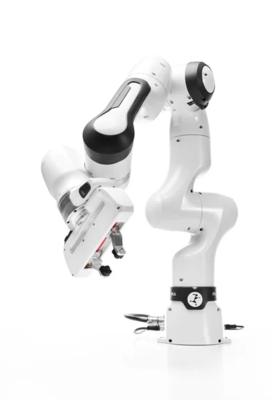
Panda
The Franka Panda (also known as the Franka Emika Panda) is a 7-DOF collaborative robotic arm designed for research and advanced manipulation tasks. It features torque sensors at each of its seven joints, enabling force-sensitive, compliant control and precise impedance control. With a 3 kg payload capacity, 855 mm reach, and ±0.1 mm repeatability, it became a de facto standard platform in academic robotics research worldwide. The robot is controlled via the Franka Control Interface (FCI) operating at 1 kHz and supports ROS, ROS 2, and MATLAB/Simulink integration.
Primary use case: Academic and industrial robotics research including manipulation, human-robot interaction, learning-based control, and motion planning
Weight
18 kg
DOF
7
Payload
3 kg
Specifications
Physical
Weight
18 kg
Degrees of Freedom
7
Locomotion
fixed_base
Manipulation
Payload
3 kg
Commercial
Availability
research
Primary Use Case
Academic and industrial robotics research including manipulation, human-robot interaction, learning-based control, and motion planning
Related news
Figure's baby AGI, Meta's China gamble, China 5Xs physical AI investment, and Agility goes to Wall Street
Agile Robots and Audi piloting humanoids ... on a task done 1 million times a day
NVIDIA's massive robotics strategy: how all the puzzle pieces fit together
New UBTECH, VW project: humanoid robots will help mass customize cars
Hello Panasonic, Telsa cuts Optimus' memory budget, and Munich takes center stage
Robots take center stage at 2026 CIFTIS in Beijing, envisioning smarter daily living
The 2026 China International Fair for Trade in Services (CIFTIS) in Beijing features robots across multiple exhibition halls, with interactive zones showcasing applications in retail, agriculture, elderly care, and cultural heritage. Notable demonstrations include a wheeled dual-arm robot deployed by China Post for postal and retail services, and humanoid robots competing in a half-marathon-themed stage in Hall 6.
Chinese-made robots steal the show at IFA 2026
Chinese-made humanoid robots dominated IFA 2026 in Berlin, with companies like Xiaomi, Unitree, and Pudu Robotics showcasing robots capable of fist-bumping visitors, dancing, boxing, and performing factory and household tasks. The exhibition featured the largest humanoid robot display in IFA's history, with China's humanoid robot market projected to grow 94 percent this year to reach $3.6 billion.
Building and buying - why Unitree Robotics’ mega IPO suggests that China may win the humanoid robot race
Unitree Robotics conducted a massively successful IPO on the Shanghai Stock Exchange's STAR Market, with shares surging 460% on the first day of trading, validating China's lead in the humanoid robot race. The article contrasts China's strategy of building affordable, approachable robots at scale with American competitors like Tesla and Boston Dynamics, whose expensive and intimidating designs may struggle for mass adoption.